Showing posts with label Denialism. Show all posts

Tuesday, 23 February 2016

Pecunia non olet

Though the name of this blog has its roots in medicine my interest has become more general. In fact, I seem to be more and more interested in the maltreatment of science and how certain factions prefer misrepresenting the facts to serve their ideology.

Just recently have I written about an exposé showing science is for sale. Meaning, you can now buy the outcome you require to protect your financial interests. Unsurprisingly there are more examples to add to that unethical behaviour.

As I initially observed, Emilie Udell for the Center for Public Integrity reported how
Critical Reviews in Toxicology and Regulatory Toxicology and  Pharmacology 
 are the go-to journals for
misleading, industry-backed articles that threaten public health by playing down the dangers of well-known toxic substances such as lead and asbestos. The articles often are used to stall regulatory efforts and defend court cases.
The article showed how the asbestos industry bought scientists to opine the link between asbestos and mesothelioma is in dispute. For an explanation on the technique used see manufactroversy.

Climate Progress updates the #Exxonknew-meme  by reporting and showing a reportage by Frank Capra from 1958:
In this film, Dr. Research (Dr. Frank Baxter) explains to The Writer (Richard Carlson) that unrestricted carbon dioxide emissions could lead to a world where “Tourists in glass bottom boats would be viewing the drowned towers of Miami.”
They conclude
Scientists have been warning us about the dangers of unrestricted CO2 emissions, global warming and climate change for over six decades. So much for the myth that climate scientists used to believe in global cooling a couple of decades ago — a myth that has been utterly debunked in the scientific literature (see here). Heck, thanks to excellent reporting by InsideClimate News, we now know oil giant ExxonMobil had been told by its own scientists in the 1970s and 1980s that climate change was human-caused and would reach catastrophic levels without reductions in carbon emissions.
Another example of politicians confusing facts for fiction: voter-fraud. John Oliver shows us the utter fiction of it.

But, this is not about science, it is about politics. By corrupting science the usual suspects are able to sabotage necessary legislation: f.e. to combat smoking related deaths, global warming, gun control, derail vaccination programs, et cetera,

Nevertheless, as I write this we still are defrauded by politicians invoking the "it is nothing more than a global hoax by liberal-commie-nazi scientists"-tactic.

All the misrepresentations by politicians evoke som paranoid response in me: Cui bono? Which leads me to conclude we are in need of some mandatory regulation in politics.
  1. Politicians must be able to say whatever they want. They should be able to make any suggestion, propose or block any law, make any claim they want.
  2. Following their suggestions (to implement, or block, policy/law) it should be mandatory to show evidence of a) the need for this proposal/its refusal, b) the proposal has the claimed effect, c) the claimed effect outweighs the expected negative impact.
  3. For the purpose of ascertaining the available facts politicians themselves are not considered experts in the field. 
  4. The evidence shown can not be "I strongly believe," or "god said so," but has to be based on a review by an independent expert in the relevant field. This expert has to a) share with us the mainstream view among the relevant experts, b) state that in case of any discrepancy between the politicians statement and communis opinio among these experts this is entirely reasonable and reflects an actual debate among experts, c) in case of politicians withholding  such studies they are obliged to mention the result and reason behind not mentioning it.
  5. In the absence of verifiable evidence politicians are obligated to either withdraw their suggestions/comments or admit they are only sharing their private opinion and that layman opinion is more important than evaluation by people with real knowledge: otherwise known as experts.
  6. Any proposal based on non-expert guestimation shall be publicly presented as make believe or truthiness
  7. Akin to nearly every other profession I would suggest accountability in case of policy that can not be reconciled with expert opinion, or lacks reasonable arguments to ignore the patently fallacious solution presented.
Concluding I think there is to much room for misstatements regarding science, and we should better protect society against those who mislead us for personal gain.


Tuesday, 9 February 2016

Corrupting science

As been noted before science is not necessarily reliable. Since monetary gains trump scientific integrity it is difficult to prevent the misrepresentation or fabrication of science. A previous post explained the use of claimed uncertainty in science confabulated by the  Merchants of Doubt.

Case in point, Emilie Udell for the Center for Public Integrity reports how a lawyer (Evan Nelson of the law firm Tucker Ellis & West) invited a scientist to publish a "scientific theory" regarding the cause of mesothelioma. Coincidentally:
Nelson defended companies that had exposed people to asbestos .........
Luckily for his clients
Nelson came up with a new culprit: tobacco.
But:
There was an obvious problem with Nelson’s “science.” Researchers for decades have exhaustively analyzed data on the health of hundreds of thousands of smokers. Since 1964, the U.S. Surgeon General has summarized the findings of study after study, none of which shows evidence that tobacco causes mesothelioma.
The scientist involved offered to write "scientific articles" meant to be used in court cases. A firm offering such services is Gradient.
A group of academic researchers were so outraged by an article on BPA [bisphenol A, which, according to hundreds of studies is linked to health problems] written by Gradient’s Julie Goodman and Lorenz Rhomberg that they wrote a lengthy response with a table listing all the “false statements” in it.
In the words of the report:
Gradient has become a leading scientific voice in trying to prevent further regulation of air pollution.
Continuing the exposé the Center for Public Integrity recounts the case of Pam Collins, who was suffering from mesothelioma allegedly caused by asbestos gloves. Shawn Acton, one of the lawyers, was confronted with a novel theory regarding the cause of mesothelioma:
Acton did a little research and discovered that Valberg [the aforementioned scientist] had just co-authored an article in the Journal of Environmental Radioactivity saying that cigarette smoke emits radiation. And he noticed that the article was funded by the law firm representing the maker of the gloves.
Acton had no idea that months earlier a lawyer at the firm, Evan Nelson, had concocted the scientific theory that Valberg was using against Collins. Or that Valberg and colleague Goodman had emailed drafts of the article in advance to the lawyer, as their contract required.
In another court case lawyers
decided to subpoena all records .....
The discovery led to e-mails showing how Nelson had commissioned three scientific articles and how its authors struggled to get it published. Eventually two got published.
Pam Collins’s lawyer said efforts by industry consultants to absolve asbestos of blame show they will say almost anything.
“Why are some of these companies putting so much money into research to be published in scientific and medical journals years and sometimes decades after they stop making the product?” Acton asked rhetorically. “Is its purpose for the advancement of medicine? Is its purpose to address a public health concern? Its purpose is for litigation. It’s science for sale.”
The article proves that even scientists are not above human nature.


Wednesday, 21 October 2015

Merchants of Doubt

In a previous post I mentioned the deliberate attempt at inventing "scientific debate." The culprits, and methods used, are extensively debated and explained by Naomi Oreskes and Erik Conway. They posit that from smoking to global warming, and other manufactroversies, there has been a concerted effort to invent doubt. As I wrote then:
We were first shown that tactic by the tabacco industry (PDF) , which despite increasing evidence smoking is detrimental to our health, made it possible to stall legislation. Their trick: manufacturing scientific doubt.
We have just been given proof that these claims are indeed not merely speculation. As it happens Exxon appears to have proven the existence of global warming decades ago yet chose to counter their own scientists by generating an industry of denialism. According to The Nation:
"... from months of careful reporting by two separate teams, one at the Pulitzer Prize–winning website Inside Climate News, and other at the Los Angeles Times (with an assist from the Columbia Journalism School). Following separate lines of evidence and document trails, they’ve reached the same bombshell conclusion: ExxonMobil, the world’s largest and most powerful oil company, knew everything there was to know about climate change by the mid-1980s, and then spent the next few decades systematically funding climate denial and lying about the state of the science."
They continue:
"But though we know now that behind the scenes Exxon understood precisely what was going on, in public they feigned ignorance or worse. CEO Lee Raymond described global warming as “projections are based on completely unproven climate models, or, more often, on sheer speculation,” and insisted—in a key presentation to China’s leading officials in 1997—that the globe was probably cooling."
The image I used in the aformentioned post aptly captured these revelations:

Another article by The Nation suggests a possible criminal case:
“The revelation that Exxon knew about the link between climate change and carbon pollution as early as 1981, and yet continued to support the decades-long campaign of denial described in the [Union of Concerned Scientists] report, strengthens the parallel with the tobacco-industry conduct that led to a civil RICO verdict against tobacco,” Senator Whitehouse told The Nation.
Which is also discussed by Greg Laden:
"The timing of this expose is interesting because it comes at about the same moment as a call to use US RICO laws to investigate and possibly prosecute those who seem to have been conspiring for a long time muddy the waters about the science of climate change in order to put off taking action that might financially hurt Big Petrol. (See also this.) "
He reanalyses their results and presents the results, showing that Exxon was amazingly accurate. As an aside I quote The Progressive:
"Greenpeace's investigation of the role of ExxonMobil in funding climate change deniers led to an interactive website, ExxonSecrets.org, where visitors can select people and organizations and view the charted connections between dozens of organizations, funding streams, and climate-denying experts active in the decades-long, $30 million effort."
The Guardian has the following to say:
"Recently, 11 House Republicans broke ranks with their party leadership to call for action against climate change. Thus far, dependency on fossil fuel industry campaign donations has played a major role in the Republican Party’s efforts to obstruct national and international climate policies. "
Which, coincidentally, underscores my point that politicians might not always have an honest and objective incentive to make realistic decisions.


Friday, 2 October 2015

Politics vs. Reality

My view on countries is that they are nothing more than oversized companies, shops if you will. We all agree that running a company boils down to being a good manager. One has to ensure there are enough resources, cheese, or toilet paper. In case of illness make sure there is a replacement. The primary goal being the survival of the enterprise. Case in point, opening a restaurant is not the same as knowing how to run it. The reason is you have to understand what the best course of action is to be a restaurateur, not which menu fits your personal believe system.

In the same vein to adequately run a country one must differentiate between ideology and verifiable reality. Just like rational people emphasise the need to adhere to science in medicine we should not ignore the wider effects denialism (more here) has on society.

The audacity with which politicians blatantly posit fact-free "facts" is both impressive as it is disheartening. Stranger still is the observation the general public lets them get away with that. Evidence critical thinking skills should be part of our educational system. Although, it might not be as simple as introducing accurate information to correct reality-challenged opinions, enter the backfire effect (PDF).

Thinking of examples is easy, one can mention the follwing falsehoods, that remain "unresolved" controversies to this day. In light of the numerous stories refuting their premise voters remain annoyingly loyal adherents to these peddlers of humbug, a result that to me is utterly unpalatable.

Global Warming
Confronted with all the scientific evidence supporting the position the earth is warming and humans are part of the cause, special interest groups have reacted with an assault on the science and have been able to make us believe there still is doubt, doubt which politicians use to sabotage necessary reforms.

In short, politicians keep repeating the factually incorrect claim that the science is not settled.

To make things worst AP has decided that calling people who deny the science "denier" is no longer allowed. Yet again proof of journalism refusing to report facts.

Capitalism
We all know how the free market has made us all extremely happy. The notion that government is out to prevent us all from making money has led to deregulation. Luckily, the removal of laws preventing some to become obscenely rich has made our lives alot easier

Part of protecting our right to make money the world has envisioned a free trade agreement (TTIP) presented as a solution to our economic woes to come. My biggest problem with it is the lack of transparancy. Meaning: nobody, except the lucky few, are allowed to see what this agreement entails. Because of that many have voiced opposition, even observed it threatens democracy itself. How? I see you think. Should a country enact laws which might impact expected revenue, (think smoking, food, cars, et cetera), the affected company may sue the country in what in essence is a secret court: the National sovereignty and investor-state dispute settlements (ISDS), more here, here, here, here, here, here and here. Many fear this will be an incentive not to enact consumer protective laws. Which, if you are VW, is a good thing.     

Another truism among monetary wizards is the notion that reducing taxes on the rich, paired with lower wages/increased taxes on the rest of us plebs, stimulates the economy, better known as trickle down economics


Too Big to Fail, and Jail 
After convincing politicians to remove our protections against a financial collaps, completely unexpected the world was on the brink of disaster as the economy crashed. To avert the end of times politicians decided to rescue the financial world because it was impossible to let them go bankrupt.

The concept "too big to fail" is something I do not subscribe to. But, as I have no background in economics, I will not force my opinion upon you. So, conceding the premise the logical next step is to reduce the size of our financial institutions and update their ethics. This is something politicians have refused to mandate. In addition to that we have seen a reluctance to either investigate or sufficiently punish widespread criminal behaviour.


Guncontrol
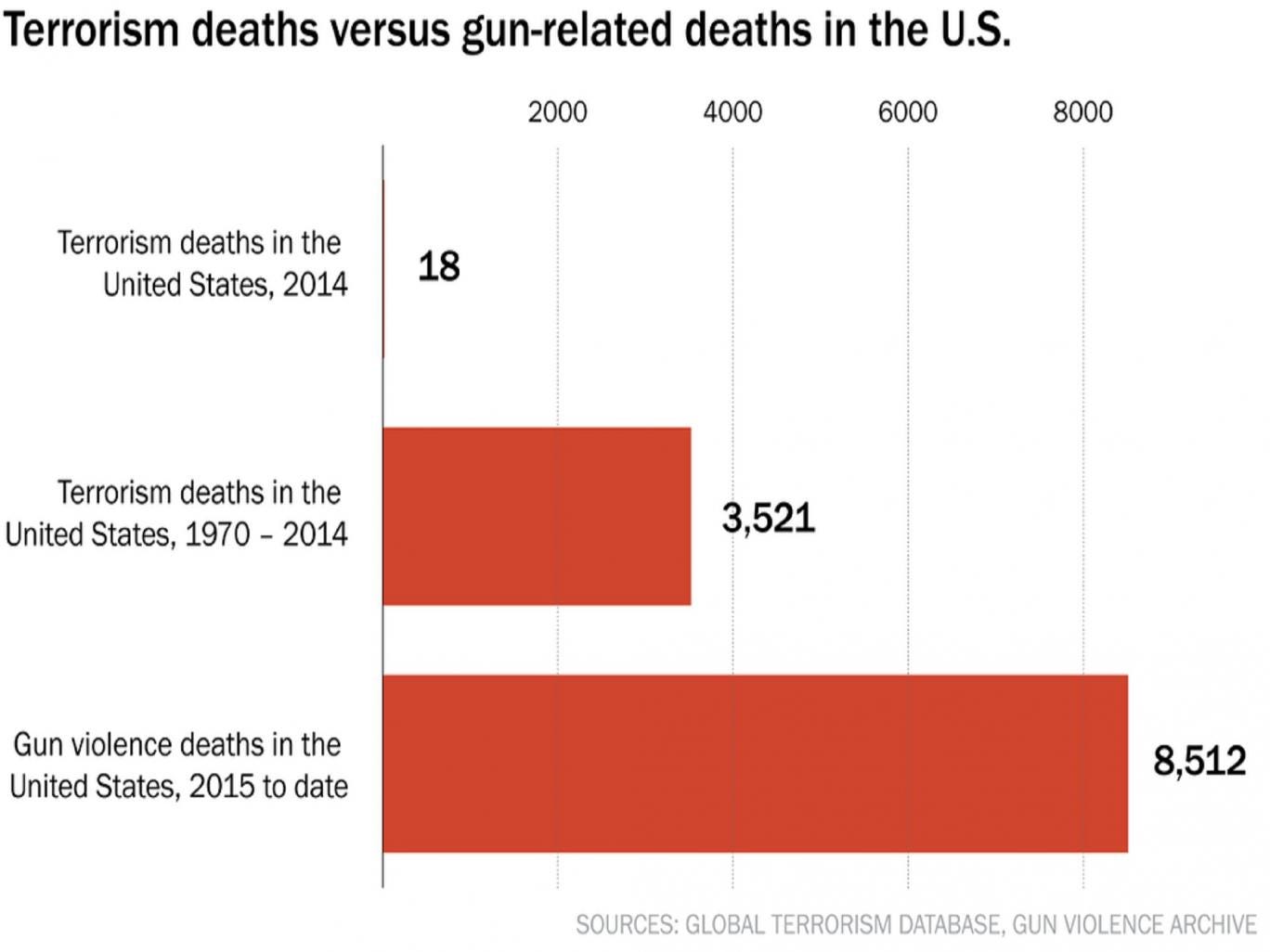
This is aimed at politicians that refuse to acknowledge reality surrounding the unlimited availability of murder tools. Despite impressive results of curtailing gun ownership in other countries. But ideology, and hysteria, trump common sense, and emperical data showing gun control works. Worse, because of politics we are no longer allowed to even collect and analyse data pertaining to gun violence.  


Terrorism
Following the attacks on the US of A in 2001 politicians claimed this attack, WMD and support of international terrorism meant they had to invade Iraq. While already evident before the invasion those politicians ignored the evidence refuting those claims which simultaneously pointed to the actual culprit.

Even today we fail to recognise our role in creating Islamic State by destabilising the region and supporting one of the worst regimes around today. The entire notion that "war" is the solution to complicated sectarian conflicts is risible. Strangely enough we are shocked when this non-diplomatic approach to solving global challenges causes another catastrophe. Needless to say, nobody ever remembers how things got started, or how human rights are just bargaining chips. Worse still, after history has proven you do not know what you are talking about we happily listen to your insights yet again.

Coincidentally, the inflated fear of those "men with beards and funny names" has opened up opportunities for those interested in making some money and those that feel civil liberties are overrated anyway. Which most of us think is just fine.


For years I have wondered how it is that politicians are able to make a plethora of incorrect statements without the possibility of correcting them. Looking at the rest of society I notice all the jobs I am aware off have some kind of quality control. For whatever reason politics knows no such system. Despite the tedious political debates presented as such we have no objective means of steering the political process back to reality.

Would it not be great if we finally get to implement measures to save the planet and thereby ourselves, or if we stop wasting resources on solving problems that do not exist?

What if we implement some quality control measures to check whether politicians espouse reality-based opinions. The Baloney Detection Kit: Carl Sagan’s Rules for Bullshit-Busting and Critical Thinking seems like a good place to start. We can steal some of his suggestions and turn those into the following: 
  1. Politicians must be able to say whatever they want. They should be able to make any suggestion, propose or block any law, make any claim they want.
  2. Following their suggestions (to implement, or block, policy/law) it should be mandatory to show evidence of a) the need for this proposal/its refusal, b) the proposal has the claimed effect, c) the claimed effect outweighs the expected negative impact.
  3. For the purpose of ascertaining the available facts politicians themselves are not considered experts in the field. 
  4. The evidence shown can not be "I strongly believe," or "god said so," but has to be based on a review by an independent expert in the relevant field. This expert has to a) share with us the mainstream view among the relevant experts, b) state that in case of any discrepancy between the politicians statement and communis opinio among these experts this is entirely reasonable and reflects an actual debate among experts, c) in case of politicians withholding  such studies they are obliged to mention the result and reason behind not mentioning it.
  5. In the absence of verifiable evidence politicians are obligated to either withdraw their suggestions/comments or admit they are only sharing their private opinion and that layman opinion is more important than evaluation by people with real knowledge: otherwise known as experts.
  6. Any proposal based on non-expert guestimation shall be publicly presented as make believe or truthiness
  7. Akin to nearly every other profession I would suggest accountability in case of policy that can not be reconciled with expert opinion, or lacks reasonable arguments to ignore the patently fallacious solution presented.
Yes, I realise we now get into Through-the-Looking-glass territory:
The asnswer is: we employ a system that optimises the objectivity of politics and minimises ideological influences. Just as we are used to in the rest of society: think regulations for the automotive industry, hospitals, construction industry, your local restaurant, hotel, et cetera.

Anyway, the goal is to make visible that politics is not seldom based on wishful thinking if not good old-fashioned smoke and mirrors. Who knows, it might even reduce political disputes as it limits the possibility to abuse reality without getting corrected.

Feel free to augment/amend my proposal in comments.


Update: Unfortunately we have an oportunity to see whether politicians are willing to choose society over ideology. What will the response be to Obama pleading:
"Obama appealed to voters to elect politicians committed to strengthening gun control and to gun owners to ask themselves whether organisations such as the National Rifle Association, which pour large amounts of money into lobbying against restrictions, are really serving the interests of those who use weapons for sport and hunting."
Obama also asked to compare the effects of gun violence and terrorism.
 Will politicians choose the facts-based approach? Not holding my breath.

Sunday, 28 August 2011

Agnotology: or denialism as policy

When I entered medical school I strongly believed that knowledge was the answer to most, if not all, problems. By the same token I thought that in any debate, just offering your opponent a well-supported argument had to lead to its acceptance.

Not so. Apparently, for psychological reasons humans reject evidence that contradicts strongly held beliefs. Hence the need for denialism. Because of that I coined the phrase: there is no cure for stupidity. As I remarked before, there are two sides to that coin. One, there are those that sincerely refuse to accept scientific facts, mostly through lack of understanding. Eventhough studies show increasing their knowledge does not help, I sincerely hope it does. Unfortunately, they evade venues that offer critical thinking courses.

Unfortunately, there is another group. They do not reject science, they understand and accept it. However, their monetary gains, religious and political powers, are severly damaged should certain scientific facts become known and accepted by the general public. To protect profitable companies, policies, et cetera they attempt to keep uncomfortable information hidden, and are actively aided by politicians. And if that does not work they soften the blow by pointing out the science is not settled, or even making us distrust science.
We were first shown that tactic by the tabacco industry (PDF) , which despite increasing evidence smoking is detrimental to our health, made it possible to stall legislation. Their trick: manufacturing scientific doubt.

Following that success new acolytes appeared: global warming does not exist, vaccination kills, evolution is merely another opinion, the financial industry Ponzi scheme, non-medicine-medicine, only plebeians commit crimes, we guarantee your safety, privacy will be the end of us all, militarism and ignoring the law breeds democracy. The recurring theme is misinformation, misrepresentation, and fullblown denialism.

Putting as many sticks as possible in the wheels of the bicycle called science has become a major strategy which is detailed in Merchants of Doubt. The cause is self-evident: if people hear smoking kills you lose customers, once evolution is accepted and the bible is proven to be a set of fairy tales that book can no longer be used to indoctrinate the rabble, if global warming is true you need to make costly adaptations to factories and cars, if security theatre does not prevent terrorist attacks we won't spent billions on the military-industrial-complex incarnation called security firms.

That technique of creating confusion is known as agnotology. According to Dah Wiki this:
is the study of culturally-induced ignorance or doubt, particularly the publication of inaccurate or misleading scientific data.
The term was invented by Robert Proctor in 1992. An example is given by Stéphane Foucart for The Guardian:
A famous internal memo issued by the US cigarette manufacturer Brown & Williamson put it bluntly: "Doubt is our product." The campaign by the tobacco industry to spread ignorance, which became a deliberate ploy in the 1950s, has since been copied in other fields.
Hmm, doubt as a product, where have I heard that before?

Today the intertoobs are a highly effective method of disseminating misinformation. There are numerous echo chambers promoting "alternative views" by experts without knowledge. Countering the deliberate manufacture of debate becomes increasingly difficult. Especially when exposing those fabricating facts results in abuse like the recent unpleasantness.

Not only facts are misrepresented, also language is conscripted  in this war on reason. Something Orwell years ago explained to us, which is why today we call such abuse of language Orwellian.

The sad thing is I expect powerful factions to mislead in order to gain money and power, I have been turned into a cynic by Il Principe combined with a lack of interest in the latest Hollywood gossip. What annoys me is that the one institute whose raison d'être should be exposing such blatant fraud is refusing to do so. Or, in the case of one news organisation, participating in the scheme to mislead us. Commenting on the P.R.-departments we call media David Roberts writes:
There's one thing we haven't learned from climategate (or death panels or birtherism). U.S. politics now contains a large, well-funded, tightly networked, and highly amplified tribe that defines itself through rejection of "lamestream" truth claims and standards of evidence. How should our political culture relate to that tribe?
We haven't figured it out. Politicians and the political press have tried to accommodate the shibboleths of the right as legitimate positions for debate. The press in particular has practically sworn off plain judgments of accuracy or fact. But all that's done is confuse and mislead the broader public, while the tribe pushes ever further into extremity. The tribe does not want to be accommodated. It is fueled by elite rejection.
At this point mainstream institutions like the press are in a bind: either accept the tribe's assertions as legitimate or be deemed "biased." Until there is a way out of that trap, there will be more and more Climategates.
Confronted with such opposition to change, i.e. advancement of knowledge, I am reminded of my school days. During physics lessons Lenz's law was introduced to me.
An induced current is always in such a direction as to oppose the motion or change causing it.
Add to that a pinch of Newton:
To every action there is always opposed an equal reaction.
which completes my version of quantum-woo to explain The Force is behind the anti-science movement.

Update: Added image borrowed from Waldenswimmer.

Update II: Yet another brilliant picture from Joe Romm, for Think Progress:


Nice flow-chart of The Denier Industrial Complex.

Wednesday, 17 August 2011

The Galileo Movement

Last year I, though I was not alone in this, noticed the tendency of cranks to invoke Galileo as proof of the inherent scientific basis of their refusal to accept the scientific consensus.

This time it is discussed by Scientific American as part of the epidemic, involving global warming denialism, in Australia. Apparently there is a new anti-science group Down Under:
Launched in February, the Galileo Movement is getting much of its lift from its influential "patron," conservative radio personality Alan Jones, one of the most popular broadcasters in Australia, who has touted the effort on his daily morning show.
For the casual observer this is yet more evidence that Merchants of Doubt was spot on, which makes Scientific American observe:
By casting doubt on the science, the need for behavior change is blunted – an approach the tobacco industry successfully employed throughout the 1980s and '90s to delay efforts to warn the public of smoking's dangers.
Independent Australia has more details on the who, and what, here and here. This campaign is part of the current non-debate over there on how to tackle the consequences of global warming. As expected there is vocal opposition to science whenever it interferes with ideological and/or monetary interests. As I noted before:
What these "sceptics" fail to notice is that Galileo made observations based in science, something they invariably refuse to do. Since his conclusions contradicted religious dogma, i.e. ideology, the Church attacked him. His findings were opposed not on their merits but by appeal to authority: the bible. Enter the anti-science brigade. The mere fact their stance is rejected too proves they, like Galileo, are persecuted. Wrong. They clearly misunderstand the meaning of the word.
Strangely enough the Galileo Movement missed the discovery that Galileo was wrong, although Ethan Siegel and Orac are less certain of that proposition. For those interested in the less fantasy infested version of reality I suggest visiting Skeptical Science, Open Mind, New Anthropocene, Climate Shifts, and RealClimate.

Update: Borrowed picture from Matthew Francis who also discusses this incarnation of the anti-science movement.

Update II: Found a post by Bycicle User on this topic.

Update III: The Galileo gambit is also explained by The Tracker.

Tuesday, 19 October 2010

Correcting "misinformation week"-week

The Ministry for the promotion of infectious diseases has anounced a “Vaccine Awareness Week” from november 1-6. To counter the spread of the denialism-virus by the we-need-no-stinkin'-science-crowd David Gorski has suggested an antidotum. As Steven Novella writes:
we will be posting science-based information about vaccines, and countering anti-vaccine misinformation throughout the week. Look for these posts on Respectful Insolence (Orac has also announced the event), here at NeuroLogica, and on Science-Based Medicine.
The team supporting science consists of the people at Science-Based Medicine and Neurologica, Orac, PalMD, Tod W., and Science Mom. If you are resistant to the denialism-virus because of a predilection for the scientific method you can follow their contributions through their pages or via Twitter using hastag #vaxfax. Naturally, should you be suffering from, and willing to be vaccinated (pun intended) against, the promote-ignorance-at-all-costs-virus you are more than welcome too.

Update: Other participants are Science-Based Pharmacy, and Scott Gavura, and Skepacabra. Seed Magazine offers an explanation as to why people are unwilling to vaccinate:
As Sam Harris argues in his new book The Moral Landscape, we have a bias against sins of commission rather than sins of omission.     
This means that the consequences of action are perceived as morally worse than those of inaction. Even if the result is the same. In the manufactroversy surounding vaccination
they see the government or meddling doctors causing autism—a sin of commission. But parents who don’t get their children vaccinated and end up causing a measles outbreak are only committing the lesser sin of omission.
Humans are also naturally biased to favor their own children over others’ kids, and to prioritize present dangers (like the growing autism crisis) over remote ones (like the dim memory of measles). Other biases may be in effect as well. Powerful biases such as these are difficult to overcome, but perhaps as we begin to see more and more potentially deadly outbreaks of preventable diseases, public opinion will change. Our attention to the question of autism might then be redirected towards research on effective treatments—but sadly, only at the cost of serious illness in children who might have been protected by vaccines.
While CNN reports on yet another victim, Matthew Lacek, of the infectious-disease-promotion-movement. And in 2008:
Measles—a highly contagious disease-causing virus—is making a comeback in the U.S., thanks to parents fears over vaccines. Fifteen children under 20, including four babies, have been hospitalized and 131 sickened by the red splotches since the beginning of this year in 15 states and the District of Columbia, according to the U.S. Centers for Disease Control.
According to Scientific American. But hey, we all know vaccines are evil.

Update II: The fruits of years of being educated by irrational fanatics, as CNN tells us:
Whooping cough, also known as pertussis, has claimed the 10th victim in California, in what health officials are calling the worst outbreak in 60 years.
Luckily, pertussis is not as dangerous as vaccinations are.

Sunday, 29 August 2010

ScienceMobsters

Rational people know, and abhor, the pandemic involving the denialist-virus. We now appear to have an attempt by Liz Ditz (Twitter) to bring those valliant people opposing the anti-science movement together in what is called ScienceMobsters. Some of them you may recognise from my blogroll. This science promotion movement is, as Liz explains here and here, the result of:
a series of tweets from Homeopathyinfo (http://twitter.com/homeopathyinfo/).
The ensuing debate made her compile a list of potential candidates. The criteria for inclusion are:
* science / reality based
* Forthright about challenging pseudoscience (homeopathy, chiropractic for anything other than low back pain, reiki, etc.)
The secret society members, and related things, can be found at #Sciencemob. At present it appears to focus on nonsensical medical claims, though global warming and evolution are not excluded. Suggestions for new members you can  leave at the Sciencemob Twitter feed. My blogroll has some good candidates so Liz:)

Thursday, 29 July 2010

Conspiracy theory in denialism

At the moment I am in Norway, a blog on that journey is coming. In the mean time here are some sites on denialism, detailing how to invent controversy by invoking numerous conspiracies, global warming denial, and how the anti-science movement shares the characteristics that are prosaicly termed crank magnetism.

Thursday, 8 July 2010

The Dunning-Kruger effect

Part of the myriad of reasons people are resistent to science is the Dunning-Kruger effect. At Pro-Science Kristjan Wager explains the concept, and links to the original article that gave us the term.

Update: On a related note,  Ed Brayton discusses a new, and unusual, interpretation of cognitive dissonance theory. Watching the Deniers discusses an article in Political Behaviour that:
clearly demonstrates the fact that people will cling desperately to a misconception despite overwhelming evidence that contradicts that belief.
He refers to climategate as the example "par excellence" of what the article clarifies. This resembles my conclusion the anti-science crowd is suffering from some form of delusional disorder.

Update II: The effect stands for the notion that the least knowledgeable individuals feel they are the best qualified to opine on a certain topic. This because they lack the ability, as a result of insufficient training, to recognise the flaws in their conclusions.

Sunday, 4 July 2010

Journalism: if only ......

Knowledge precedes understanding. Therefore to be adequately informed, and protected against the denialism-virus, we need good reporting. The principal problem with journalists today is they feel that presenting a story objectively means you do not check the facts, you only have to tell both sides: i.e. be fair and balanced. What this means is shown by Glenn Greenwald in the latest incarnation of the neutrality-virus. Harvard published a study which:
examines how waterboarding has been discussed by America's four largest newspapers over the past 100 years, and finds that the technique, almost invariably, was unequivocally referred to as "torture" -- until the U.S. Government began openly using it and insisting that it was not torture, at which time these newspapers obediently ceased describing it that way
Just like any guilty person the accused advanced an utterly unconvincing defence to which Greenwald responds:
The New York Times issued a statement justifying this behavior on the ground that it did not want to take sides in the debate.  Andrew Sullivan, Greg Sargent and Adam Serwer all pointed out that "taking a side" is precisely what the NYT did:  by dutifully complying with the Bush script and ceasing to use the term (replacing it with cleansing euphemisms), it endorsed the demonstrably false proposition that waterboarding was something other than torture. 
 To continue with:
Worse, to justify his paper's conduct, Keller [the executive editor of The Times] adds "that defenders of the practice of water-boarding, 'including senior officials of the Bush administration,' insisted that it did not constitute torture."
Then there is:
Cameron Barr, National Security Editor of The Washington Post, which also ceased using "torture" on command:  "After the use of the term 'torture' became contentious, we decided that we wouldn’t use it in our voice to describe waterboarding and other harsh interrogation techniques authorized by the Bush administration." 
Greenwald rhetorically asks:
Could you imagine going into "journalism" with this cowardly attitude:  once an issue becomes "contentious" and one side begins contesting facts, I'm staying out of it, even if it means abandoning what we've recognized as fact for decades.  And note how even today, in an interview rather than an article, Barr continues to use the government-subservient euphemism:  "waterboarding and other harsh interrogation techniques authorized by the Bush administration."  Just contemplate what it means, as Keller and Barr openly admit, that our government officials have veto power over the language which our "independent media" uses to describe what they do.
Such subservient behaviour I find disturbing. Is a journalist not supposed to do the exact opposite? He predictably notes the prescient words of George Orwell. The same Bill Keller is mentioned by Marcy Wheeler, and she illustrates Keller's hypocrisy by citing his contradictory behaviour as a reporter:
NYT reporter Bill Keller has a long history of referring to torture as torture without bowing to the spin of the governments who use it.
Unfortunately this misleading way of informing the public is not limited to politics. Mike the Mad Biologist writes about science journalists that are convinced one should present "opposing views," and how Ivan Oranski observed -commenting on a tweet by Maggie Koerth-Baker, a freelance science journalist in Minneapolis:
I never tell my students to get "opposing viewpoint" but to get outside perspective -- one that may agree with the study or the main idea being put forward by a source.
Anyone interested in factually and accurately reporting a story, or is political correctness more important? When do we demand the return of actual journalism in stead of the current "it's not our job to comment on the veracity of a story, we only report"-doctrine?

Update: Following the above exchange Glenn notes an AP story which explicitly states that China is guilty of torture. He posits:
Given the standards of Good Journalism prevailing in the U.S. media, as taught to us just this weekend by high-level executives at the NYT and The Washington Post (and previously at NPR):  what right does AP have to "take sides" in this dispute by substituting its own judgment about "torture" for the Chinese Government's?  Beyond that, given that the U.S. Government has officially adopted a definition of "torture" that plainly does not include a few cigarette stubs on an arm, shouldn't that preclude any Good Journalist from using the term in this subjective and biased way?  I hope AP will be apologizing to the Chinese shortly for its act of journalistic irresponsibility.  It's not the role of journalists to take sides this way.
Not only the Chinese "torture:"
As lysias notes in comments, the North Vietnamese have emphatically denied that the techniques they used on John McCain constituted "torture."
His post ends with an odd update:
Strangely, at some point after I wrote this, the above-linked AP article was re-written so as to edit out the word "torture" in the two places that word appeared to describe what the Chinese did (though the original language can still be seen in this old version of the AP article).  Perhaps, as recommended here, AP took to heart the Bill-Keller/WashPost/ NPR standard -- if a Government denies it did X, then a Good Journalist does not say that it did X -- and edited its article accordingly.
What any really Serious and Unbiased Journalist understands is that if somebody says the earth is flat it is inherently unprofessional to point out that this is a fringe and refuted position. To illustrate the double standard in the MSM Greenwald wrote another post:
Journalists like to claim that they are devoted to transparency, but it's always striking how so many of them exempt themselves and their own media outlets from those "principles."
The sudden refusal to call torture torture leads Marcy Wheeler to speculate whether this enabled public support for the use of it by the US administration.

Update II: Come to think of it, whenever the press engage in doublespeak, in order to manipulate their audience into accepting the official government position, normal people call that propaganda. In my definition of journalism there is no mention of the use of propaganda. Heck, my idea of a journalist is an individual fighting to let the light in where government officials work 24/7 to keep those illegal activities in the dark.

Update III: As if the media want to illustrate the point we now have the highly hypocritical reaction to a tweet by Octavia Nasr. Both Glenn and Eric Martin give an extensive analysis of the incident to show us how Serious and Unbiased Journalists are supposed to work.  

Update IV: Another example by Glenn.

Update V: The inadequacy of science journalist Nicholas Wade is shown by Larry Moran. While Andrew Bolt is challenged by Watching the Deniers to retract his statements attacking scientists.

Update VI: Quite illustrative is this example of a Serious and Unbiassed reporter.

Update VII: Nice article on modern day "fact-checking" by The New York Times concludes:
In short, fact-checking has assumed radically new forms in the past 15 years. Only fact-checkers from legacy media probably miss the quaint old procedures. But if the Web has changed what qualifies as fact-checking, has it also changed what qualifies as a fact? I suspect that facts on the Web are now more rhetorical devices than identifiable objects. But I can’t verify that.
Update VIII: In case you missed the point I am making here is a brilliant parody by Martin Robbins.

Monday, 25 January 2010

Why science sucks

Mike Adams heroically fights for our right to know all the reasons why scientists are evil and then incoherently explains to us why science-based medicine is inferior to "natural remedies" which are solely testimonial-supported because they somehow always fail to adhere to the scientific method. Shorter Mike: alternative medicine rocks, despite lack of noticable clinical effects.

Apparently misrepresenting how modern medicine works is the way to go when no rational arguments can be found to support your believe system.

Update: Some thoughts on Adams can be found at Weird Things, while Orac has additional points to his post.

Friday, 18 December 2009

Crank magnetism revisited

Not so long ago I wrote about crank magnetism, the origin of the word, and its meaning. In short it refers to the propensity of cranks in one area to support cranks spouting unrelated nonsense. Their shared dislike of science appears to instill a mutual attraction, which was recently coined vindication of all kooks. Or, put differently, if science can be proven wrong in case of evolution, that alone proves it is also wrong on global warming. Needless to say there is some sort of logical fallacy hiding in there. Today I realised another meaning of the concept: being a crank renders the most notorious sceptics impotent in repelling hogwash and, like moths to a flame, turns them into their disciples.

That is, the "climate sceptics" have converted Randy. Because he was previously being regarded The Master of the Known Universe of Scepsis, Orac notes that Randy's recent adoption of a less sceptical worldview is already being used by the anti-science movement to discredit the current scientific consensus.

Should you still need more information showing why there is no real scientific debate on this topic just read, and study, the following articles: How to Talk to a Climate Skeptic, Seven Answers to Climate Contrarian Nonsense, 50 reasons why global warming isn't natural, The Global Warming Skeptics vs. The Scientific Consensus.

Update. Clearly the "controversy" surrounding global warming is linked to scientists refusing to "teach the controversy" regarding evolution. Yet another incarnation of the classic form of crank magnetism.

Tuesday, 15 December 2009

Denialism

Confronted with a cornu copiae of disinformation, and a scientifically-challenged public, Denialism: How Irrational Thinking Hinders Scientific Progress, Harms the Planet, and Threatens Our Lives, by Michael Specter, is mandatory reading. In the words of The New York Skeptic:
To me, this is a great book to show to a non-skeptical friend.  It lays out our views, even quotes a lot of our guys, without coming across as condescending or arrogant.  It lays out the case for science in a clear and compassionate way, forming a wonderful bridge between the skeptical mindset and a non-skeptical audience.
In case you were looking for that intelligent Christmas gift: this is it.

Don't forget The Age of Stupid, among others, which I consider to be complementary to this book.